Understanding Industrial Honey Processing
Honey processing is an important stage between raw honey collection and commercial packaging. It involves carefully controlled operations that prepare honey for storage, bulk distribution and different food manufacturing applications.
For a Honey Manufacturer India, industrial processing requires the right combination of equipment, hygienic handling, temperature management and quality inspection.
Unlike small-scale honey preparation, industrial processing handles larger quantities and requires consistent procedures across multiple batches.
The objective is to remove unwanted physical impurities, manage crystallisation when necessary, maintain product characteristics and ensure that the finished honey meets applicable quality requirements.
Processing methods can vary depending on honey variety, moisture content, crystallisation, intended application and buyer specifications.
A well-planned processing facility helps maintain product consistency while supporting efficient commercial production.
Major Stages of Industrial Honey Processing
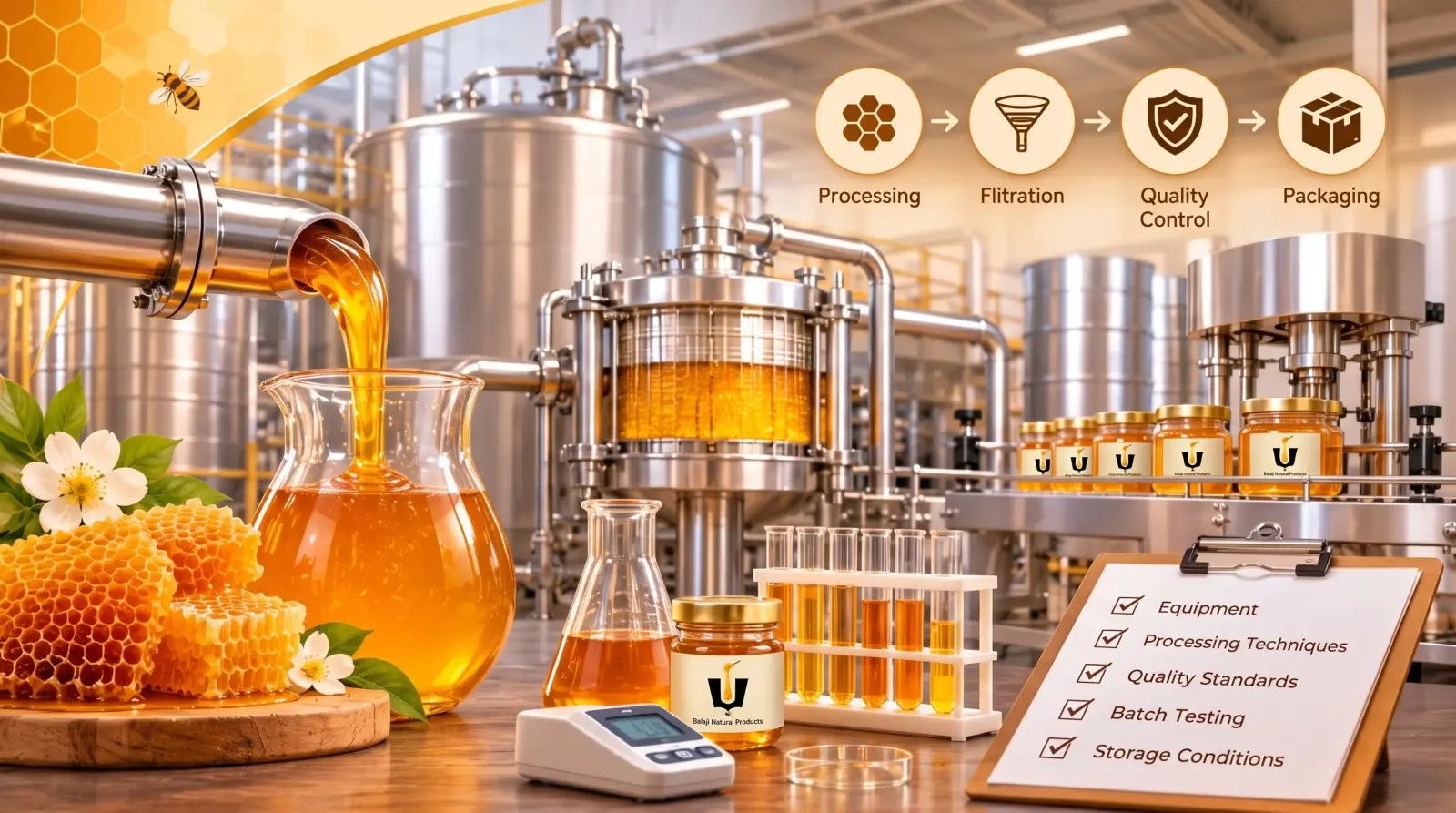
Industrial honey processing generally involves several connected stages.
Each stage has a specific purpose and should be managed according to the product's characteristics.
1. Raw Honey Receiving and Inspection
The process begins when honey arrives at the processing facility from beekeepers or collection centres.
The receiving team checks the condition of the containers and verifies the supplied product details.
Important inspection activities include:
Checking container condition and seals.
Verifying honey variety and source information.
Recording supplier and batch details.
Checking the received quantity.
Collecting representative samples.
Reviewing available quality documentation.
Initial testing may include moisture content, colour, aroma and visible impurities.
Additional laboratory analysis can be performed according to the purchase specification.
This step helps identify unsuitable or damaged material before it enters the production process.
2. Honey Warming and Decrystallisation
Honey naturally crystallises over time.
The rate of crystallisation depends on its glucose content, floral origin, moisture and storage conditions.
Crystallised honey can be difficult to pump, transfer and filter.
Industrial facilities may therefore use controlled warming equipment to make the product easier to handle.
Common equipment includes:
Honey decrystallisation chambers.
Temperature-controlled warming rooms.
Jacketed heating tanks.
Heated transfer systems.
Industrial honey pumps.
The objective is to soften or liquefy crystallised honey without unnecessary exposure to excessive heat.
Temperature and treatment duration should be selected according to the product and intended process.
Excessive heating can affect important quality characteristics, including enzyme activity, colour and HMF levels.
3. Coarse Straining and Removal of Physical Impurities
Raw honey may contain naturally occurring physical materials such as beeswax particles, pollen clumps and small pieces of comb.
Coarse straining helps remove larger unwanted particles before further processing.
Common equipment includes:
Stainless-steel strainers.
Coarse mesh filters.
Filter baskets.
Industrial honey sieves.
Gravity filtration systems.
Food-contact surfaces should be made from suitable materials and designed for effective cleaning.
The straining process should remove unwanted physical debris without unnecessarily changing the honey's natural characteristics.
4. Fine Filtration and Clarification
After coarse straining, honey may undergo additional filtration depending on the desired product specification.
Fine filtration helps remove smaller suspended particles and improves visual clarity.
Industrial facilities may use:
Pressure filtration systems.
Filter housings.
Food-grade filter bags.
Stainless-steel mesh filters.
Centrifugal clarification equipment.
The filtration level should be selected carefully.
Very fine filtration can remove pollen and other naturally occurring components along with unwanted particles.
Therefore, buyers should specify whether they require strained, filtered or ultrafiltered honey.
These terms should not be treated as interchangeable.
5. Settling and Homogenisation
After filtration, some processing facilities use settling tanks to allow remaining suspended particles or air bubbles to separate.
This helps improve the consistency of the product before packaging.
Homogenisation or controlled mixing may also be used when required by the product specification.
For businesses handling multiple batches of the same variety, controlled blending can help achieve consistent colour, flavour and other agreed characteristics.
However, blending must follow the applicable regulations and buyer requirements.
Batch identity and traceability should be maintained throughout the operation.
Essential Equipment Used in Industrial Honey Processing
The equipment selected for a honey processing plant depends on production capacity, product type and the desired level of automation.
A commercial facility may use several specialised machines connected through a controlled processing line.
Honey Decrystallisation Chamber
A decrystallisation chamber is used to soften crystallised honey stored in drums, buckets or other containers.
It provides controlled warming conditions to make the honey easier to transfer and process.
Jacketed Heating Tanks
Jacketed tanks allow controlled heating through an external heating arrangement.
They may also include mixing systems to improve temperature distribution.
These tanks are useful when honey requires controlled warming before filtration or transfer.
Industrial Honey Pumps
Honey is a viscous product, so suitable pumping equipment is important.
Food-grade pumps help transfer honey between storage tanks, filtration units and filling machines.
The pump design should be compatible with the product's viscosity and processing temperature.
Industrial Filtration Systems
Filtration systems remove unwanted suspended particles.
Depending on the process, manufacturers may use coarse strainers, bag filters, pressure filters or other suitable equipment.
The selected filtration system should match the intended product specification.
Stainless-Steel Storage Tanks
Bulk storage tanks provide a controlled location for holding processed honey.
They should have suitable food-contact surfaces, secure closures and appropriate cleaning arrangements.
Some systems also include temperature monitoring and level indicators.
Honey Filling and Packaging Machines
Filling machines help transfer processed honey into the required packaging format.
Commercial facilities may use:
Semi-automatic filling machines.
Automatic liquid filling systems.
Drum filling equipment.
Bucket filling systems.
Sealing and capping machines.
Weighing and labelling systems.
The packaging line should maintain hygiene and accurate filling quantities.
Temperature Management During Honey Processing
Temperature management is one of the most important considerations in commercial honey production.
Honey contains naturally occurring enzymes and other compounds that may be affected by excessive heating.
Uncontrolled heating can increase HMF levels and reduce diastase activity.
It may also affect colour, aroma and flavour.
A professional processing facility should therefore establish suitable temperature limits for each operation.
Important practices include:
Use calibrated temperature sensors.
Avoid unnecessary heating cycles.
Monitor heating duration.
Ensure uniform temperature distribution.
Use suitable cooling arrangements when required.
Maintain temperature records.
Follow product-specific processing procedures.
The temperature used for decrystallisation should not automatically become the temperature used for every other processing operation.
Each stage has a different purpose and requires appropriate controls.
Quality Control Considerations in Commercial Honey Processing
Processing equipment alone cannot guarantee finished-product quality.
Regular inspection and laboratory testing are necessary to confirm that honey meets the required specifications.
A Honey Manufacturer India should establish quality checks at different stages rather than relying only on final product inspection.
1. Moisture Content
Moisture content affects honey stability and its susceptibility to fermentation.
A refractometer or suitable laboratory method can be used to determine moisture content.
The result should be compared with the applicable product standard and buyer specification.
2. HMF Testing
Hydroxymethylfurfural (HMF) is an important quality parameter in honey.
Its concentration can increase due to heating and prolonged storage.
Testing helps assess whether the product meets the relevant requirements.
3. Diastase Activity
Diastase is a naturally occurring enzyme in honey.
Its activity can be affected by heating and storage conditions.
Testing helps evaluate an important aspect of honey quality.
4. Sugar Composition
Sugar analysis provides information about the composition of honey.
Relevant parameters may include:
Fructose.
Glucose.
Sucrose.
Total reducing sugars.
Fructose-to-glucose ratio.
These results help verify compliance with applicable product specifications.
5. Adulteration Screening
Honey authenticity is an important concern for commercial buyers.
Depending on the required testing programme, laboratories may use techniques such as C4 sugar analysis, isotope-ratio testing and advanced NMR screening.
Additional tests may be required for specific syrup markers.
No single test should automatically be considered sufficient for every type of adulteration.
6. Residue and Contaminant Testing
Food manufacturers and international buyers may require additional testing for pesticide residues, antibiotics, heavy metals and other contaminants.
The required testing programme should reflect the destination market, applicable regulations and intended product application.
Hygiene and Food Safety in Honey Processing Facilities
A hygienic production environment is essential for commercial honey processing.
Even when honey has naturally low water activity, contamination can occur through unsuitable equipment, poor handling or unclean packaging.
Food manufacturers should establish documented hygiene procedures.
Important measures include:
Cleaning food-contact equipment regularly.
Maintaining suitable employee hygiene practices.
Preventing cross-contamination.
Inspecting tanks, pipes and transfer systems.
Using appropriate food-grade lubricants and materials.
Controlling pests.
Maintaining cleaning and sanitation records.
A documented Food Safety Management System (FSMS) helps establish consistent controls throughout receiving, processing, storage and packaging.
[External Link: FSSAI – Hygiene Requirements and Food Safety Management Systems]
Packaging and Storage After Industrial Processing
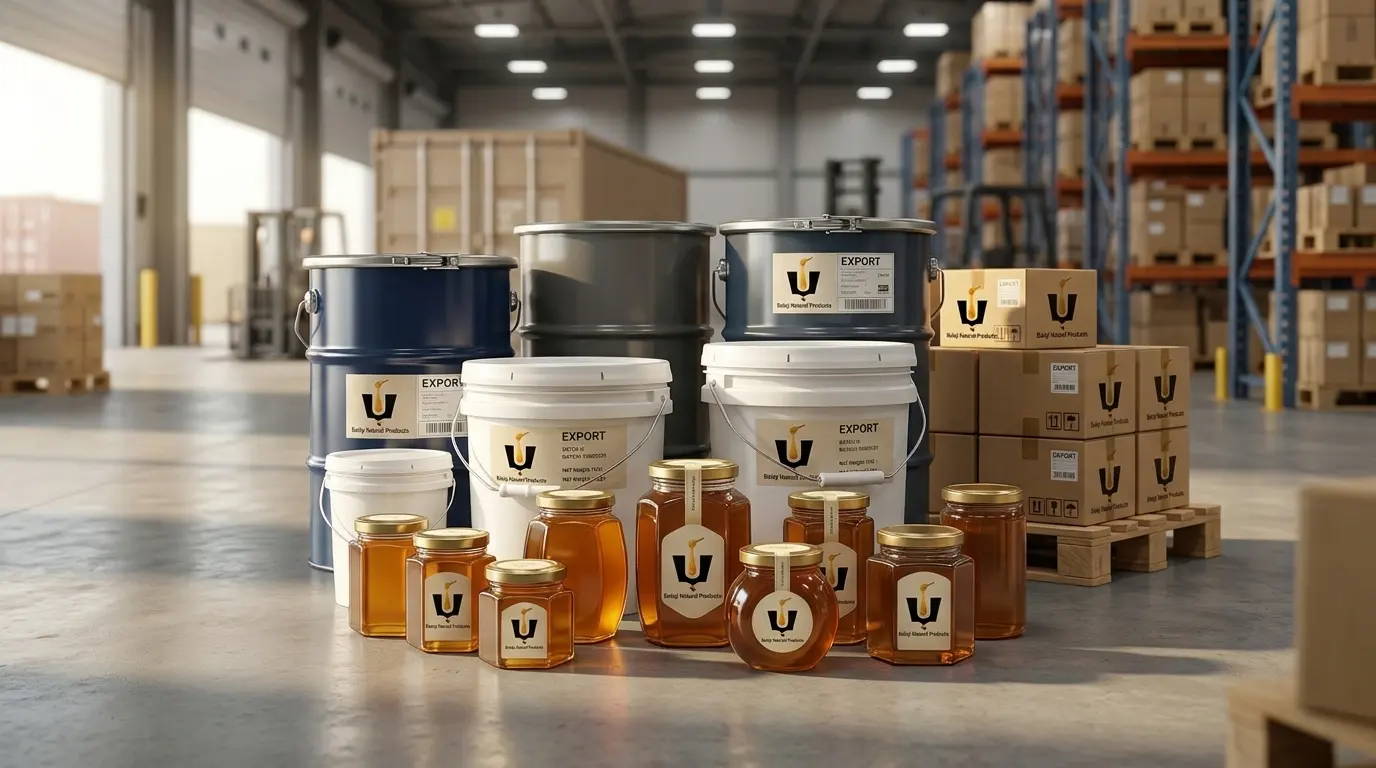
Once processing and quality checks are complete, honey is transferred into suitable packaging.
The selected packaging depends on the buyer's requirements and intended application.
Common commercial packaging formats include:
Food-grade plastic buckets.
Metal drums with suitable food-grade internal protection.
Stainless-steel containers.
Food-grade cans.
Retail jars and bottles.
Before filling, containers should be inspected for cleanliness, suitability and damage.
Closures should protect the product from moisture exposure and contamination.
Every finished batch should carry suitable identification details.
These may include the product name, batch number, net quantity, packing date and other applicable labelling information.
Processed honey should be stored in suitable conditions away from direct sunlight, excessive heat and moisture.
How to Select the Right Industrial Honey Processing Method
Not every honey variety requires exactly the same processing approach.
The correct method depends on the honey's physical characteristics and the buyer's intended use.
For example, a buyer requiring honey with minimal visible particles may specify a particular filtration level.
A food manufacturer purchasing honey as an ingredient may prioritise moisture content, sugar composition and consistency.
An international importer may request additional authenticity testing and destination-specific documentation.
Before selecting processing equipment or techniques, manufacturers should evaluate:
1.Expected daily and monthly processing capacity.
2.Honey varieties being handled.
3.Initial moisture and crystallisation conditions.
4.Required filtration level.
5.Desired packaging formats.
6.Applicable quality standards.
7.Cleaning and maintenance requirements.
8.Future production expansion.
This approach helps avoid unnecessary equipment costs while ensuring that the processing line meets actual business requirements.
Why Choosing an Experienced Honey Manufacturer Matters
Commercial buyers need more than a supplier that can provide honey in large quantities.
They also need reliable communication, consistent product specifications and suitable documentation.
When evaluating a Honey Manufacturer India, businesses should consider its ability to support bulk procurement and understand different buyer requirements.
Important factors include:
Availability of different honey varieties.
Bulk packaging options.
Batch identification and traceability.
Quality testing arrangements.
Product specification documentation.
Consistent supply coordination.
Understanding of domestic and international buyer requirements.
Balaji Natural Products works with commercial buyers seeking bulk honey for food manufacturing, distribution and other business applications.
Its honey range includes varieties such as Sidr, Litchi, Multiflora, Mustard and Eucalyptus.
Bulk packaging options include drums, cans and buckets, depending on the product and order requirements.
Buyers can discuss their preferred honey variety, quantity, packaging and quality specifications before placing an order.
[Internal Link: Explore Bulk Honey Varieties and Packaging Options at Balaji Natural Products]
Conclusion
Industrial honey processing requires a combination of suitable machinery, controlled handling procedures and consistent quality inspection.
From raw honey receiving and decrystallisation to filtration, storage and packaging, every stage contributes to the finished product.
Selecting appropriate equipment and managing temperature carefully can help protect important honey characteristics.
Regular laboratory testing and documented hygiene practices further support product quality and commercial consistency.
For businesses sourcing from a Honey Manufacturer India, understanding these processing stages makes it easier to evaluate supplier capabilities and define procurement requirements.
Balaji Natural Products supports commercial buyers looking for bulk honey varieties and packaging solutions.
Looking for bulk honey for your business? Contact Balaji Natural Products to discuss your product requirements, preferred varieties and packaging options.